
Written and reviewed by the Grit Insurance Group team · Last reviewed August 12, 2026
Grit is an independent brokerage that places contractor insurance and surety bonds across the 31 states we write in, led by a principal holding the CIC designation with more than 30 years in insurance ownership. We came out of the trades we insure. Coverage and bond requirements are verified against each state's own statutes, rules and agency publications, and they are subject to current state code. Meet the team or call (801) 505-5500.
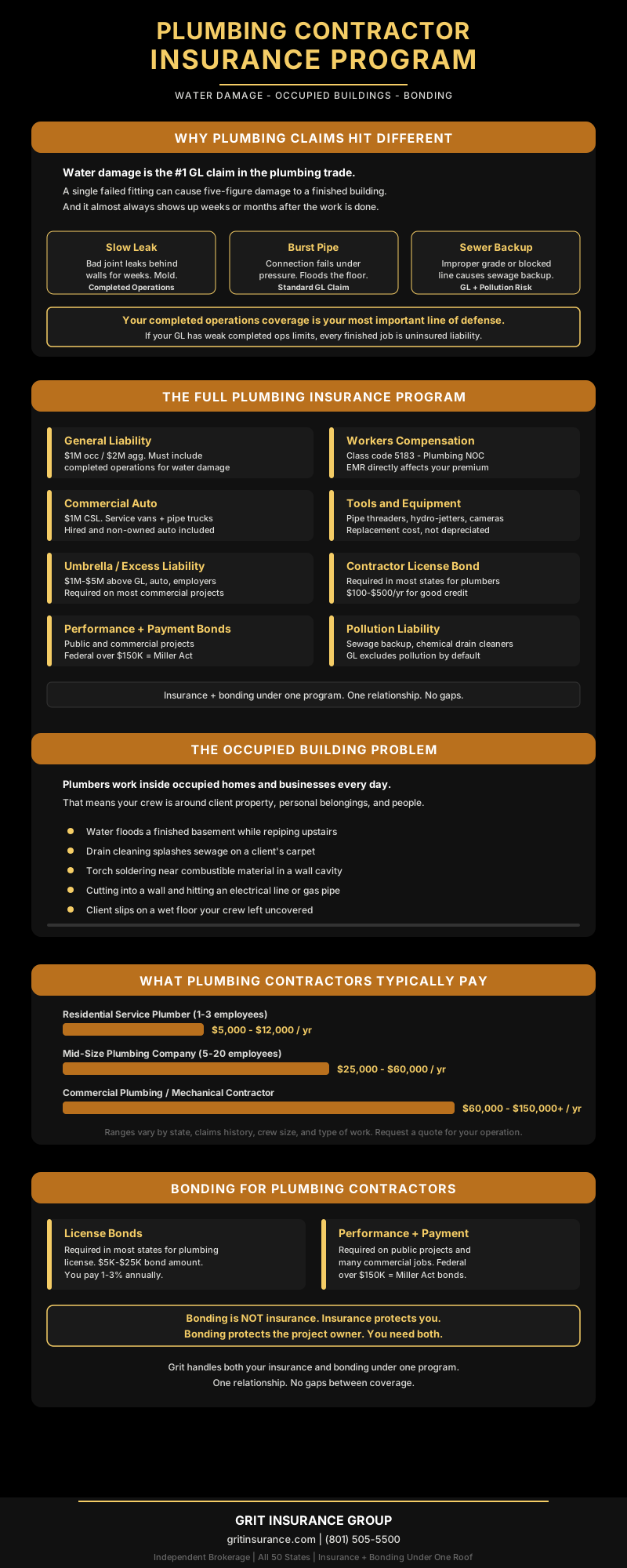
The Full Plumbing Contractor Insurance Program
A complete plumbing contractor insurance program covers more than just liability. Here is what each piece does and why it matters for your trade.
General Liability
General liability is the foundation. For plumbers, the key coverage within GL is completed operations - the part of the policy that responds when your finished work causes damage after you leave the job. Water damage from plumbing failures is one of the most common and most expensive GL claims in the construction trades.
Plumbing contractors are typically classified under ISO class codes 95648 (plumbing - commercial) or 97047 (plumbing - residential), though codes vary by carrier. Your classification affects your rate, so it matters that your policy reflects the actual mix of work you do. If you are doing both new construction and service/repair work, make sure both exposures are covered.
Standard GL limits for plumbing contractors are $1,000,000 per occurrence and $2,000,000 aggregate. Many general contractors and project owners require those as minimums. Some larger commercial or public projects require higher limits, which is where an umbrella policy comes in.
Workers Compensation
Plumbing work is physical. Your crew lifts heavy pipe, works in crawl spaces, operates power tools, and deals with hot water and soldering equipment daily. Workers comp covers medical costs and lost wages when an employee gets hurt on the job.
The standard workers compensation class code for plumbing is 5183 - Plumbing NOC (Not Otherwise Classified). This code applies to installation, service, and repair work. Your Experience Modification Rate (EMR) directly impacts your premium. An EMR above 1.0 means you are paying more than the industry average. An EMR below 1.0 means you are paying less. More importantly, many general contractors will not let you on their jobsite if your EMR is above 1.0 - it is a disqualifier on bid prequalification forms.
Keeping your EMR low comes down to a real safety program, prompt injury reporting, and managing claims aggressively with your carrier. Grit helps plumbing contractors build a workers comp strategy that lowers costs and keeps you eligible for the projects you want.
Commercial Auto
Every plumbing contractor runs a fleet of service vans and trucks. These vehicles carry your crew, your tools, your parts inventory, and your reputation. Commercial auto insurance covers liability if one of your drivers causes an accident, plus physical damage to the vehicles themselves.
For plumbers, the added exposure is what is inside the van. A loaded service vehicle can carry $10,000 to $30,000 in tools and parts. Standard auto policies do not cover cargo or tools - that is an inland marine exposure. Make sure your commercial auto and inland marine policies work together so there are no gaps.
Hired and non-owned auto coverage is also important if employees ever drive personal vehicles for work purposes, even just running to the supply house.
Inland Marine - Tools and Equipment
Plumbing contractors rely on specialized equipment that is expensive to replace. Pipe cutters, threading machines, sewer cameras, hydro-jetters, press tools, and diagnostic equipment can add up to six figures across a fleet. Inland marine insurance covers tools and equipment against theft, damage, and loss - whether they are on the jobsite, in the van, or in your shop.
This is not homeowners insurance for your tools. Inland marine is a commercial policy designed for equipment that moves from location to location. It covers what commercial auto and commercial property do not. If your crew's van gets broken into overnight and $15,000 in tools disappears, this is the policy that responds.
Umbrella and Excess Liability
An umbrella policy sits on top of your GL, auto, and workers comp policies and provides additional limits when a claim exceeds the underlying coverage. For plumbing contractors, this matters because water damage claims can escalate quickly - especially in commercial buildings, multifamily properties, or any structure with finished interiors and expensive contents.
Umbrella limits of $1,000,000 to $5,000,000 are common for plumbing contractors. The cost is relatively low compared to the protection it provides. Many commercial contracts require it.
How Much Does Plumbing Contractor Insurance Cost
Insurance costs for plumbing contractors vary based on revenue, payroll, number of employees, claims history, the type of work you do, and where you operate. There is no single answer that applies to every plumber.
That said, here are the factors that drive your premium the most:
- Annual revenue and payroll - higher numbers mean higher premiums across GL and workers comp
- Claims history - a clean loss run gets you better rates. Frequent water damage claims will cost you.
- EMR (Experience Modification Rate) - directly multiplies your workers comp premium
- Work mix - new construction vs. service/repair vs. commercial vs. residential all rate differently
- State - workers comp rates, GL class code rates, and auto rates all vary by state
- Bonding needs - if you need performance bonds, your overall insurance program becomes part of the underwriting picture
A small residential plumbing shop with two or three employees might pay $5,000 to $15,000 per year for a basic GL, workers comp, and auto package. A larger commercial plumbing contractor with 20 employees, a fleet of vehicles, and bonded projects will pay significantly more. The only way to get an accurate number is to quote it with real data.
Grit does not guess at pricing. We run your actual numbers through multiple carriers to find the program that fits your operation and your budget. Call us at (801) 505-5500 or request a quote online.
Plumbing Subcontractor Insurance Requirements
If you work as a subcontractor under a general contractor, you will need to meet their insurance requirements before you set foot on the jobsite. This is not optional. No compliant certificate of insurance, no work.
Here is what most GCs and project owners require from plumbing subcontractors:
- Certificate of Insurance (COI) - proof that your policies are active and meet the required limits. Your agent issues this directly to the requesting party.
- Additional Insured endorsement - the GC, project owner, and sometimes the lender need to be listed as additional insureds on your GL policy. This gives them coverage under your policy for claims arising from your work.
- Waiver of Subrogation - prevents your insurance carrier from going after the GC's insurance to recover claim payments. Most contracts require this on GL, auto, and workers comp.
- Minimum limits - $1,000,000/$2,000,000 GL is standard. Some projects require $5,000,000 or more in total limits (GL plus umbrella).
- Workers comp coverage - required in almost every state. The GC will verify your policy is active and your EMR is acceptable.
Getting certificates issued fast matters in this business. A GC calls on Monday, needs the COI by Tuesday, and the job starts Wednesday. Grit's team handles certificate requests the same day so you do not lose work over paperwork.
Why Plumbing Contractors Work with Grit
Grit Insurance Group is an independent brokerage. That means we work with dozens of carriers - not just one. We are not captive to a single company's appetite or pricing. When a carrier does not want to write plumbing contractors in your state or at your experience level, we go to the next one. And the next one. Until we find the right fit.
We also handle bonding in-house. Most P&C agents hand off bonding to someone else or do not do it at all. At Grit, surety and insurance live under one roof. That means your bonding program and your insurance program are coordinated, your financials are positioned correctly for underwriters on both sides, and you are not managing two separate agent relationships.
We came from the trades. We understand what a plumbing contractor's day looks like, what keeps you up at night, and what you actually need from your insurance program. No scripts. No runaround. Direct answers from people who know this business.
Coverage Plumbing Contractors Are Most Often Missing
- Products-completed operations with a real limit and a long additional insured tail. Your worst claim almost always arrives after the job is signed off, which means it is paid out of the products-completed operations aggregate and not the general aggregate. Those are separate buckets, and a plumber who burns through the completed operations aggregate on one bad building has nothing left for the next one. General contractors require additional insured status including products and completed operations, carried forward on every renewal for as long as the statute of limitations runs.
- Contractors pollution liability. A standard general liability policy carries a broad pollution exclusion, and plumbing work runs straight into it: sewage escaping into a building or waterway, a gas line release, a fuel oil line, disturbed lead or asbestos on old pipe insulation, or contaminated soil out of a service trench. Published requirements name plumbing by trade in the list of subcontractors that must carry pollution liability at $1M per incident and $2M aggregate.
- Installation floater. Plumbing stages expensive material in a building for days or weeks before it is finished and accepted. Copper, fixtures, water heaters and boilers sit on site, and copper is a theft target. An installation floater covers that material from the time it leaves your shop, through transit and temporary storage, until the work is accepted. Your tools floater does not cover it, because that policy covers what you keep and this covers what you leave behind. Read the exclusions, because many installation floaters will not cover material being worked on underground.
- Rework and faulty workmanship coverage, sold as contractors errors and omissions. General liability is written to pay for the damage your bad work causes, not for redoing the bad work itself. The exclusion takes out property damage to your own work once it falls in the products-completed operations hazard, on the reasoning that replacing defective work to meet the contract is a business risk rather than an insurable liability risk. The carve-out only applies where the damaged work was done for you by a subcontractor, so it does not help the plumber whose own crew made the joint.
What Your State Requires, and Who Has To Be Named
Most plumbing insurance pages say requirements vary by state and stop there. They vary in ways that decide whether your filing is accepted. Grit verified these against each state's own statutes, rules and agency publications, and every state links through to the full breakdown.
| State | Liability minimum for licensure | Who must be named, and the catch |
|---|---|---|
| Alabama | Proof of current liability insurance, with no dollar minimum published | The Board itself at 445 Dexter Ave must be the certificate holder, and the insured name must match the applicant exactly. The $1,000,000/$2,000,000 figures you will find quoted are not licensing minimums - they come from Division of Construction Management Form C-8 Article 37, which governs state building contracts. Minimum net worth and working capital of $10,000 to license at all. |
| Arizona | None. A license bond instead, $2,500 to $100,000 by classification and volume | The ROC takes no insurance filing whatsoever. Residential contractors additionally pay into the Residential Recovery Fund or post a second bond of $200,000. Bond amount steps with contemplated gross volume, so growing past a threshold means raising the bond. |
| California | None for most licensees. LLCs: $1,000,000 cumulative, rising $100,000 per person of record above five, capped at $5,000,000 | B&P 7071.19, and the policy must come from an admitted California insurer or an approved surplus lines carrier. Every licensee posts a $25,000 bond; LLCs add a $100,000 employee bond. C-8 concrete, C-20 HVAC, C-22 asbestos, C-39 roofing and C-61/D-49 tree service must carry workers comp even with zero employees. |
| Colorado | GL $1,000,000 per occurrence and $2,000,000 aggregate at PPRBD; Fort Collins $2,000,000 aggregate | There is no statewide license, so this is municipal. A lapse suspends the license automatically at PPRBD, and Fort Collins keeps a license current only while bond and insurance are. One PPRBD filing covers nine jurisdictions. |
| Georgia | GL $300,000 residential-basic, $500,000 light commercial and commercial | The Board in Macon as certificate holder. Binders, information pages, policies and declaration pages are all refused - it must be a signed certificate, and an individual applicant must be the named insured, not their company. Workers comp at three or more employees. |
| Idaho | GL $300,000 single limit, including products and completed operations | From an Idaho-authorized insurer. A floor set in 2006 and never raised, so treat it as the registration minimum rather than the coverage decision. No bond at all. |
| Illinois | Roofing: $250,000 property damage and $500,000 bodily injury, each occurrence | The license is cancelled without a hearing on the termination date of your bond, and on proof that insurance lapsed. No grace period. The amounts live in the rule at 68 Ill. Adm. Code 1460.20, not in the statute that most pages cite. |
| Kansas | Roofing registration: a liability certificate of not less than $500,000 | K.S.A. 50-6,125, and it is filed with the Attorney General rather than a licensing board, which is why roofers looking for a contractor board never find it. Kansas licenses no general contractors, so roofing carries the only statewide insurance minimum. Cities license separately. |
| Louisiana | GL $100,000 residential and home improvement, $50,000 mold remediation | A liability trust fund at the same amount is accepted instead of a policy. Commercial applicants file no insurance certificate at all. Workers comp required alongside. |
| Maine | None required for licensure | Maine licenses no general contractors at all. It regulates the contract instead, and a home construction contract over $3,000 must be written, with the down payment capped at one third of the price. |
| Michigan | None required for licensure | The widely quoted $100,000 figure is not in the law, and the statute it is cited to is about an unlicensed builder being unable to sue for payment. Nothing filters your competitors, so your own certificates carry the whole burden. |
| Mississippi | GL $300,000 per occurrence and $600,000 aggregate | MSBOC as certificate holder, and the insured name must match the license name exactly. Workers comp at five or more employees. A Certificate of Responsibility holder must also disclose to the owner at signing whether they carry GL, in type larger than the rest of the contract. |
| Missouri | Statewide electrical license: $500,000 liability | And a bond posted with every political subdivision you work in. The state license removes local exams, never local bonds. Outside electrical there is no state license and no state minimum. |
| Montana | Montana-issued workers compensation | Montana does not accept another state's workers comp in construction. Your home-state policy does not travel, and contractors from Idaho, Wyoming and the Dakotas discover it after winning the job. |
| Nebraska | Workers compensation only, on an ACORD 25 | Department of Labor as certificate holder. If the coverage lapses you are removed from the registered contractor list until your agent files a current certificate. |
| Nevada | No GL minimum. Workers compensation is a condition of licensure | Industrial insurance compliance, or a signed exemption affidavit, must be on file to issue a license, to activate an inactive one, and to renew. An active license without comp on file is not a valid license. The license bond scales with your limit, and the Residential Recovery Fund covers homeowners in place of a GL mandate. |
| New Hampshire | None. No state general contractor license exists | Only electricians and plumbers are licensed statewide, so there is no board to file a certificate with. Requirements come from municipalities and from the owners and general contractors who hire you, which in practice means the contract sets your limits. |
| New Mexico | No general liability minimum in the rule | But workers comp compliance is a condition of license validity under Section 60-13-23, so a comp failure invalidates the license. Every license also carries a $10,000 bond, and it is a code bond rather than a contract bond. |
| North Carolina | None. The Board states there is no insurance requirement for licensing | Financial responsibility instead: working capital of $17,000 limited, $75,000 intermediate, $150,000 unlimited. A surety bond substitutes for the working capital entirely at $175,000, $500,000 and $1,000,000. Workers comp is still North Carolina law, it is simply not a license condition. |
| North Dakota | A liability certificate naming the Secretary of State as certificate holder | Plus Workforce Safety and Insurance verification. No dollar minimum is published, so the certificate itself is the requirement. |
| Ohio | $500,000 contractor liability insurance | Must sit in one contracting company name. The figure is set by the licensing board and published on its application, not fixed in the Revised Code, so confirm it at renewal rather than assuming last year's number. |
| Oklahoma | $50,000 GL per plumbing, electrical or mechanical license | CIB as certificate holder, and both the bond and the certificate must be in the individual license holder's name, not the company's. $50,000 is far too low for real commercial MEP work - meeting the minimum and stopping is the exposure. |
| Oregon | Scaled to your endorsement: residential $100,000 to $500,000 per occurrence, commercial $500,000 per occurrence to $2,000,000 aggregate | The CCB pairs every bond amount with an insurance amount, so the two move together. Hold both a residential and a commercial endorsement and you file two bonds but one policy, written at the higher of the two amounts. Commercial General Contractor Level 1 is an $80,000 bond with $2,000,000 aggregate; a number of surety sites publish $75,000 for it, which is out of date. |
| Pennsylvania | $50,000 personal injury and $50,000 property damage | HICPA registration through the Attorney General, required of anyone doing more than $5,000 of home improvement work a year. Registration is not a license - no exam, no financials, no experience - but your PA number must appear on every advertisement, contract, estimate and proposal, and non-compliance can make the contract unenforceable. |
| South Carolina | None for general or mechanical contractor licensure. Alarm and fire sprinkler registrations: $100,000 | That $100,000 gets quoted as though it covers every South Carolina contractor. It does not. GC and MC licensure runs on financials or a bond: Group 1 is a $20,000 bond for a $100,000 job limit, through Group 5 at $350,000 for unlimited. The bond is a full substitute for the CPA financial statement. |
| Tennessee | GL scaled to your monetary limit, plus workers comp unless exempt | The board publishes the schedule separately from the statute, so confirm the tier that applies to your limit rather than assuming. New since July 1, 2026: a bond of at least 50% of your monetary limit can replace the CPA-reviewed or audited financial statement entirely. Monetary limit is 10 times the lesser of working capital or net worth. |
| Texas | Air conditioning and refrigeration: Class A $300,000 per occurrence and $600,000 aggregate; Class B $100,000 and $200,000 | No state general contractor license exists, so most trades face no state insurance minimum at all. The licensed trades do, and TDLR will not issue without it. |
| Utah | GL $1,000,000 per incident and $2,000,000 total | DOPL as certificate holder, plus workers comp or a Labor Commission waiver. Raised from $100,000/$300,000 effective April 20, 2026. The $3,000,000 aggregate you may have read about was the original proposal and was pulled back. |
| Virginia | None. Class A and B document net worth or equity instead: $45,000 and $15,000 | A financial statement, a CPA review or audit, or a surety bond on the Board's own form - any one of the three satisfies it. Class C has no financial threshold at all. Third-party sites publish per-class GL minimums for Virginia that appear nowhere in DPOR's application or instructions. |
| Washington | GL $200,000 public liability plus $50,000 property damage, or $250,000 combined single limit | L&I as certificate holder. Washington runs a monopolistic workers comp system, so comp comes from the State Fund and never from a private carrier. Specialty contractors also post a $15,000 bond, general contractors $30,000. |
| Wyoming | None. No state contractor license exists | Cities and counties license instead, so the requirement changes by jurisdiction rather than at the state line. Casper, Cheyenne and Laramie each run their own program. Plan coverage around the owner's contract, because no state floor is going to set it for you. |
Three patterns travel to any state you work in. A lapse is a licensing event, not just an insurance one, and several states suspend or de-register automatically with no hearing. The certificate holder is state-specific, so naming the wrong entity gets the filing rejected even when the coverage is right. And in a growing number of states a surety bond is an accepted substitute for the financial statement - North Carolina, South Carolina, Virginia and, since July 2026, Tennessee all let a bond stand in place of CPA-prepared financials or a working capital test. That turns a bond into a way to qualify for a license, not just a box to check after you have one.
Grit verified every row above in all 31 states we write in, from each state's own statutes, rules and agency publications rather than from other insurance blogs. Several of the figures circulating online are misattributed - Alabama's are lifted from a state construction contract form, South Carolina's from a specialty registration, and Virginia's do not exist. Call (801) 505-5500 and we will confirm what your state actually requires before you file.
Frequently Asked Questions
What insurance does a plumbing contractor need?
At minimum, most plumbing contractors need general liability with completed operations coverage, workers compensation, commercial auto, and inland marine for tools and equipment. If you are bidding bonded projects, you will also need surety bonds. Many contractors add an umbrella policy for additional limits. The exact program depends on your state, the type of work you do, and what your contracts require.
How much does plumbing contractor insurance cost?
Costs vary based on revenue, payroll, claims history, EMR, work type, and location. A small residential plumber might pay $5,000 to $15,000 per year. A larger commercial operation with bonded projects will pay more. The only accurate way to know is to get a quote based on your actual numbers. Call Grit at (801) 505-5500 for a program review.
Do plumbers need a surety bond?
Yes, in most states. A contractor license bond is required to obtain or renew a plumbing license. Bond amounts vary by state - typically $5,000 to $25,000. If you bid on public works or large commercial mechanical contracts, you will also need bid bonds, performance bonds, and payment bonds. Take the Bond Scorecard to see where your bonding program stands.
What workers comp class code applies to plumbing?
The standard NCCI workers compensation class code for plumbing contractors is 5183 - Plumbing NOC (Not Otherwise Classified). This covers plumbing installation, service, and repair work. Some states use modified codes or have state-specific classifications. Your carrier and agent will assign the correct code based on your operations.
Does plumbing insurance cover water damage claims?
Yes - if your policy includes completed operations coverage, which it should. Completed operations is the part of your general liability policy that covers property damage caused by your finished work. If a fitting you installed fails six months later and floods a building, completed operations responds to that claim. Without it, you would be paying out of pocket. This is the most important coverage a plumber can carry.
What is an additional insured endorsement?
An additional insured endorsement adds another party - usually a general contractor or project owner - to your general liability policy. It gives them coverage for claims that arise from your work on their project. Almost every subcontract requires it. Your agent adds the endorsement and issues a certificate of insurance to the requesting party. At Grit, we handle these same-day.
Can I get bonded with bad credit?
Yes, but it depends on the bond type and amount. For small license bonds under $25,000, many sureties will approve applicants with credit scores in the 600s - sometimes lower. Larger performance and payment bonds require a stronger financial picture, but credit is only one factor. Business financials, work history, and backlog all matter. Grit works with sureties that specialize in harder-to-place accounts. We find the path to yes. Start with the Bond Scorecard to see where you stand.
If a joint I soldered fails and floods a finished basement, does my general liability pay to fix my pipe too?
It pays for the flood, not for the pipe. General liability is built to cover the damage your work does to other property, which here is the drywall, the flooring, the cabinets and the owner's belongings. The standard form excludes property damage to your own work once the job is complete, because replacing defective work to meet your contract is treated as a business risk rather than an insurable one. There is an exception, but it only applies where the failed work was performed for you by a subcontractor, so it does not help you if your own crew made the joint. If the rip-and-replace to reach your pipe is the expensive part, that is a gap you have to buy back on purpose, usually through a rework or contractors errors and omissions endorsement.
My general contractor is asking for $5 million and I carry $1 million. Do I have to rewrite my policy?
Usually no. Plumbing is one of the trades general contractors routinely move into a higher limit tier, and the requirement documents generally allow you to reach the number by stacking excess or umbrella limits on top of your existing general liability rather than buying a $5 million primary. Read the requirement closely, because the limit is often the easy part. The harder items are additional insured status that includes products and completed operations, a primary and noncontributory endorsement, a waiver of subrogation, and an obligation to keep that additional insured status in place on every renewal for as long as the statute of limitations runs. Those endorsements are what actually shift the claim onto your policy, which is the point of the requirement. Watch the self-insured retention rules too, since many contracts refuse a retention that only you can satisfy.
How is my workers comp premium actually calculated, and why do quotes vary so much between states?
The mechanics are simple. Your payroll is divided by 100, multiplied by the rate for your class code, then adjusted by your experience modification factor. Most plumbers land in class 5183, Plumbing NOC and Drivers, which includes your drivers rather than rating them separately. The variation is not carriers being inconsistent, it is that the rate itself is a state number, and the instruments differ: New York publishes a loss cost that your carrier multiplies by its own factor, and California does not even use a single plumbing class, splitting into high wage and low wage versions and reclassifying payroll to the more expensive one if you cannot document the hourly wage at audit. Ohio, North Dakota, Washington and Wyoming run state funds outside that system entirely. One more thing worth checking before you renew: make sure the work you are actually doing still fits the class you are rated on, because sewer line over a certain diameter, mains work in the street and fire sprinkler installation are all separate classes.
Get Your Plumbing Contractor Insurance Program in Place
Whether you are a one-truck residential plumber or a commercial mechanical contractor running bonded projects, Grit Insurance Group builds the insurance and bonding program that fits your operation. No generic quotes. No call centers. A team that knows the plumbing trade and gets your certificates, bonds, and coverage handled fast.
Call us at (801) 505-5500 to talk to someone who knows this business.
Request a Quote - tell us about your operation and we will put together a program review.
Take the Contractor Bond Scorecard - find out where your bonding program stands in five minutes.
Related: HVAC | Electrical | Excavation | Roofing | Concrete | Painting | Surety Bonds

