
You found the project. You ran your numbers. You're ready to bid. Then someone mentions you need a performance bond, and the first question is always the same: how much is this going to cost me, and does it blow up my margin?
It's the right question at the right time. Performance bond cost is a real line item on every bonded project, and if you don't know what you're going to pay before you submit your bid, you're guessing on your profitability. That's not a position any contractor wants to be in.
Here's what you need to know - with actual dollar amounts, not vague ranges.
What Does a Performance Bond Cost?
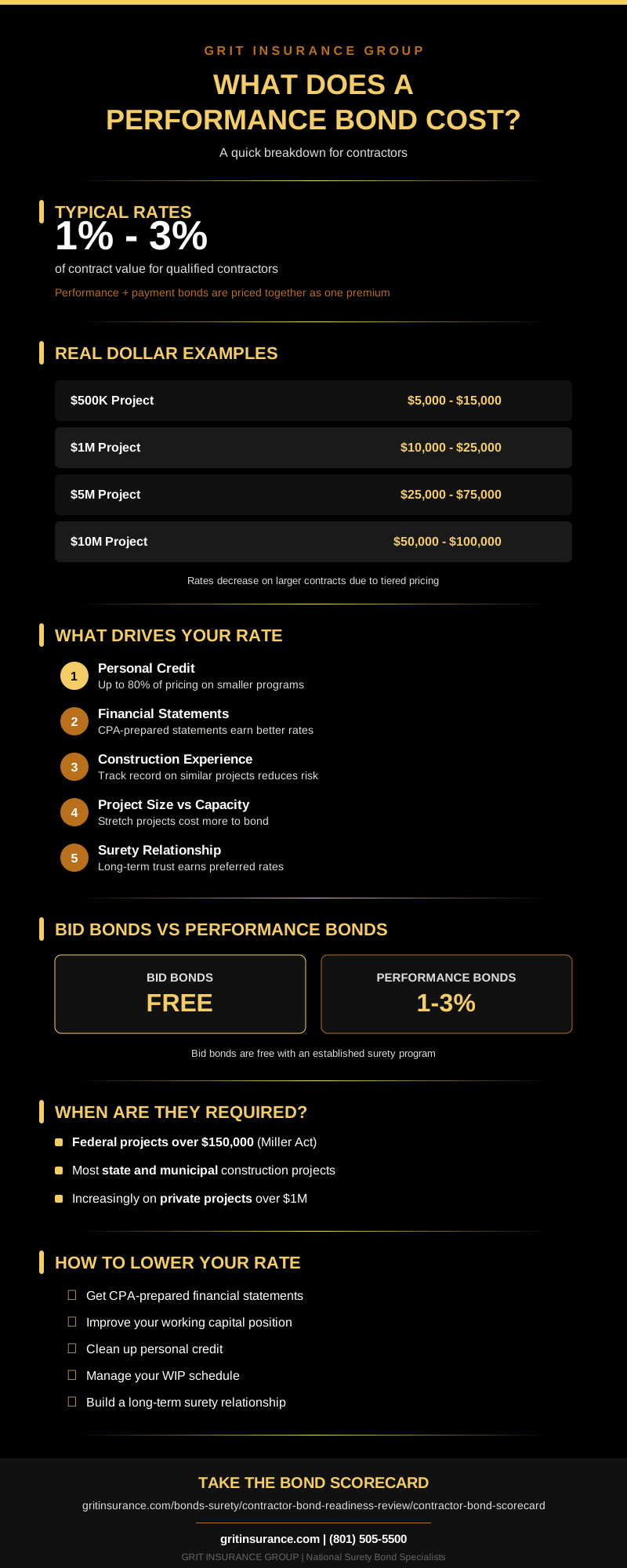
For a well-qualified contractor with solid financials and good credit, performance bond rates typically fall between 1% and 3% of the contract value. That's the premium you pay to the surety company. You don't get it back. It's the cost of doing bonded work.
Here's what that looks like on real projects:
- $500,000 contract: Performance bond premium of $5,000 to $15,000
- $1,000,000 contract: Performance bond premium of $10,000 to $25,000
- $5,000,000 contract: Performance bond premium of $25,000 to $75,000
- $10,000,000 contract: Performance bond premium of $50,000 to $100,000
Notice that the percentage tends to decrease as the contract value goes up. That's not a typo. Surety companies use tiered pricing, which means the rate per thousand dollars drops as you move into higher contract value brackets. A $10 million project doesn't cost ten times what a $1 million project costs. More on how that works below.
One critical detail: performance bonds and payment bonds are almost always priced together as a single combined premium. When a project requires both - and most do - you get one rate that covers the pair. The numbers above reflect that combined cost. You won't see a separate invoice for each bond.
Estimated Performance Bond Premiums by Contract Size and Credit
Illustrative one-time premium estimates only - not a quote. Your actual cost depends on underwriting, personal credit, financial statements, and the project. Performance and payment bonds are usually issued together for a single premium.
| Contract size | Strong credit | Average credit | Credit-challenged |
|---|---|---|---|
| $100,000 | ~$750 - $1,000 | ~$1,500 - $2,000 | ~$3,000 |
| $250,000 | ~$1,875 - $2,500 | ~$3,750 - $5,000 | ~$7,500 |
| $500,000 | ~$3,750 - $5,000 | ~$7,500 - $10,000 | ~$15,000 |
| $1,000,000 | ~$5,000 - $10,000 | ~$15,000 - $20,000 | ~$25,000 - $30,000 |
How Performance Bond Rates Are Calculated
Surety companies don't pull your rate out of thin air. They use a tiered, per-thousand rate structure filed with state insurance departments. The rate decreases at each tier as the contract amount increases.
Here's an example of how tiered pricing works on a $2,000,000 performance and payment bond for a well-qualified contractor:
| Contract Value Tier | Rate per $1,000 | Premium for This Tier |
|---|---|---|
| First $100,000 | $25.00 | $2,500 |
| Next $400,000 | $15.00 | $6,000 |
| Next $2,000,000 | $10.00 | $15,000 |
| Next $2,500,000 | $7.50 | - |
| Total on $2,000,000 | - | $23,500 (1.175%) |
This is a simplified example. Actual rate tables vary by surety company, your specific underwriting class, and the rate filings approved in your state. But the concept holds across the board - the per-thousand rate drops as the contract value increases. That's why larger contractors on bigger projects often pay a lower effective percentage than smaller contractors on smaller jobs.
Your surety agent should be able to show you the exact rate table that applies to your program. If they can't, that's a red flag.
What Factors Affect Your Performance Bond Rate
Not every contractor pays the same rate. Two contractors bidding on the same project can pay significantly different premiums. Here's what drives the difference, in order of impact.
1. Personal Credit (Up to 80% of the Pricing Decision)
For contractors with bond programs under $1 million in single-job capacity, personal credit is the dominant factor. Industry estimates suggest credit accounts for up to 80% of the pricing on credit-based bond programs. A contractor with a 750 credit score will pay substantially less than one sitting at 620.
This catches a lot of contractors off guard. They assume it's all about their business financials. For smaller programs, it's overwhelmingly about the owner's personal credit history. Late payments, collections, tax liens, and high utilization all push your rate up - or get you declined entirely.
2. Financial Statements
As your bond program grows beyond credit-only territory, your financial statements become the main event. Sureties want to see working capital, net worth, revenue trends, profitability, and debt load. CPA-prepared financial statements - reviewed or audited - carry far more weight than internally prepared numbers. Contractors with strong balance sheets and clean financials earn the best rates.
3. Construction Experience and Track Record
How long have you been doing this work? Have you completed projects similar in size and scope to the one you're bidding? Have you ever had a bond claim or a project default? Your track record tells the surety whether you can actually finish what you start. More experience on relevant projects means lower risk, which means lower rates.
4. Project Size Relative to Your Capacity
A $3 million project is routine for a contractor with $10 million in bonding capacity. That same $3 million project is a stretch for a contractor with $4 million in capacity. When a project represents a large percentage of your total program, the surety sees more risk and prices accordingly.
5. Project Type and Complexity
Straightforward public infrastructure work generally gets better rates than complex, design-heavy private projects. Road work, utility installation, and site prep are well-understood by sureties. Unusual project types, new construction methods, or work outside your normal scope may push rates higher.
6. Surety Relationship and Program History
Contractors who have worked with the same surety for years, completed bonded projects without issues, and built trust with their underwriter earn preferred rates. This is one of the most overlooked factors. Your bond rate isn't just about today's numbers - it reflects the relationship you've built over time.
Performance Bond Cost vs Bid Bond Cost
Contractors new to bonded work often confuse these two, so let's clear it up.
A bid bond guarantees you'll honor your bid price and enter into the contract if awarded. A performance bond guarantees you'll complete the work according to the contract terms. They serve different purposes at different stages of the project.
Here's the cost difference:
- Bid bonds: Typically free with an established surety program. The surety issues them at no additional charge because they've already underwritten your program. If you're paying for bid bonds, ask your agent why.
- Performance bonds: Priced as a percentage of the contract value, as described above. This is where the real premium dollars are.
When a project requires both bid and performance bonds, the process works like this: you submit a bid bond with your proposal at no cost. If you win the project, the surety converts it to a performance and payment bond, and that's when you pay the premium.
If you're comparing bid bonds vs performance bonds in detail, we've written a full breakdown on that topic.
We help contractors qualify for bonds other agents turn down. Take our 2-minute scorecard and we will tell you exactly what your bonding program looks like - and what it could look like.
The Miller Act and When Performance Bonds Are Required
Performance bonds aren't optional on most public construction work. Here's when they're required by law.
Federal Projects - The Miller Act
The Miller Act (40 U.S.C. sections 3131-3134) requires performance and payment bonds on all federal construction contracts exceeding $150,000. Both bonds must be at 100% of the contract value. There is no negotiation on this. If you're building for the federal government - military bases, federal buildings, VA hospitals, federal highway projects - you need bonds.
State and Municipal Projects - Little Miller Acts
Nearly every state has its own version of the Miller Act, commonly called "Little Miller Acts." These require performance and payment bonds on state-funded and municipal construction projects, though the thresholds vary by state. Some states set the threshold at $25,000. Others set it at $100,000 or higher. Your surety agent should know the requirements in every state where you work.
Private Projects
Private project owners aren't required by law to demand bonds, but many do - especially on larger projects. Developers, lenders, and property owners increasingly require performance bonds as a risk management tool. If you're chasing commercial, industrial, or institutional private work, expect bond requirements to come up.
The bottom line: if you want to bid public work at any level, performance bonds are the cost of entry. And the private market is moving that direction on projects above $1 million.
How to Lower Your Performance Bond Premium
Your bond rate isn't fixed forever. Contractors who actively manage their financial profile and surety relationship can lower their premiums over time. Here's what actually moves the needle.
Get Your Financials CPA-Prepared
The single biggest upgrade most contractors can make is moving from internally prepared financials to CPA-prepared statements - either compiled, reviewed, or audited. Sureties trust numbers that a CPA has touched. Reviewed statements are the sweet spot for most mid-market contractors. Audited statements open the door to the largest programs and best rates.
Improve Your Working Capital
Working capital - current assets minus current liabilities - is the metric sureties care about most on your balance sheet. More working capital means you can fund project cash flow without borrowing. That reduces risk for the surety and earns you better pricing. Talk to your CPA about strategies to strengthen your working capital position before your next financial statement date.
Clean Up Your Credit
If personal credit is driving your rate up, address it directly. Pay down revolving balances, resolve collections, and make sure there are no errors on your report. Even small improvements in your credit score can shift your bond rate meaningfully, especially on programs under $1 million.
Manage Your Work-in-Progress Schedule
Sureties want to see that you're not overbilling jobs, that your costs-to-complete are realistic, and that your backlog is manageable. A clean WIP schedule tells the underwriter you know where every project stands. Messy WIP reports are one of the fastest ways to get a rate increase or a capacity reduction.
Build the Relationship
Submit your financials on time every year. Keep your surety updated on major project wins and completions. Don't disappear for 11 months and then call in a panic because you need a bond by Friday. Sureties reward consistency and communication with better rates and higher limits.
What to Do If Your Rate Is Too High
If you're paying 3% or more on your performance bonds, don't just shop for a cheaper rate somewhere else. A high rate is a signal, not the problem itself.
Your rate is high because something in your underwriting profile is raising a red flag. Maybe your credit has issues. Maybe your financials show thin working capital or inconsistent profitability. Maybe you don't have enough experience for the projects you're chasing. Maybe your current agent placed you with the wrong surety for your class of work.
The right move is to work with a surety specialist who can diagnose the specific issue and help you fix it. Shopping for a lower rate without addressing the underlying problem just moves you from one surety to another without solving anything. And in some cases, it makes things worse - sureties talk, and a contractor bouncing between companies doesn't build confidence.
At Grit, we see this regularly. A contractor comes to us frustrated about their rate or their limits. We pull apart their underwriting file, identify what's holding them back, and build a plan to fix it. Sometimes it's a financial statement issue their CPA can address. Sometimes it's a credit problem that takes six months to clean up. Sometimes they're just with the wrong surety for their type of work, and we can move them to a better fit immediately.
The point is this: don't treat the rate as the problem. Treat it as a symptom and fix the cause.
Performance Bond Cost FAQ
How much does a performance bond cost on a $1 million project?
For a well-qualified contractor, a combined performance and payment bond on a $1 million project typically costs between $10,000 and $25,000. The exact premium depends on your credit, financial strength, experience, and the surety company's rate filing. Contractors with established programs and strong financials will be at the lower end of that range. New-to-bonding contractors or those with credit challenges may pay more.
Who pays for a performance bond?
The contractor pays the performance bond premium. However, the cost is a legitimate project expense that should be included in your bid. Most public bid forms have a line item for bond cost. On private work, include bond cost in your project overhead. The project owner benefits from the bond's protection, but the contractor carries the premium cost.
Are performance bonds and payment bonds priced separately?
No. Performance bonds and payment bonds are almost always issued together and priced as a single combined premium. You won't get separate invoices. When someone quotes you a "bond rate," that typically includes both the performance bond (guaranteeing project completion) and the payment bond (guaranteeing you'll pay subcontractors and suppliers). The Miller Act and most state bonding requirements mandate both bonds at 100% of the contract value.
Can I get a performance bond with bad credit?
Yes, but your options are limited and your rate will be higher. Some sureties specialize in non-standard or substandard credit programs. The premium on these programs can run 5% or higher, and the single-job limits are usually capped below $500,000. The better path is to work with a surety agent who can help you improve your credit profile while placing you with a surety that fits your current situation. Over time, as your credit improves, your rate comes down and your capacity goes up.
Do performance bond rates go down over time?
They can, and they should if you're managing your program well. Contractors who complete bonded projects without claims, improve their financial statements year over year, and maintain a strong relationship with their surety earn rate reductions over time. It's not automatic - you have to actively manage your financial profile. But a contractor who started at 2.5% can reasonably work their way down to 1.5% or lower as their program matures and their track record builds.
Ready to Price a Performance Bond?
Whether you need a bond for an upcoming bid or you want to build a program that qualifies you for larger work, the Grit team handles it. We don't just quote a rate - we help you understand what's driving your pricing and what it takes to improve it.
We never decline a submission. If you need a bond, we find the path to yes.
Take the Bond Scorecard to see where you stand, or call us directly at (801) 505-5500.