
If you're bidding on public construction work, you'll run into both of these bonds before the first shovel hits the ground. They're different instruments that do different jobs - but they're connected in a way most contractors don't fully understand until they're in the middle of a bid.
Here's exactly what each bond does, what it costs, and how they work together when you're chasing a bonded project.
What a Bid Bond Actually Does
A bid bond is a guarantee you submit with your bid. It tells the project owner two things: your bid is real, and if you win, you'll sign the contract and provide the performance and payment bonds required to start work.
That's it. A bid bond doesn't guarantee the project gets built. It guarantees your commitment during the bidding phase.
If you win the bid and then walk away - refuse to sign the contract, fail to deliver the required bonds - the project owner can make a claim against your bid bond. The surety steps in to cover the difference between your bid and what the owner now has to pay the next-lowest bidder. That penalty is typically capped at 5%, 10%, or 20% of your bid amount, depending on what the bid documents specify.
For most contractors with an established surety relationship, bid bonds are issued at no charge. The surety doesn't make money on the bid bond - they make it on the performance bond that follows.
What a Performance Bond Actually Does
A performance bond comes after you win. It's the guarantee that you'll complete the project according to the terms of the contract - on spec, on scope, for the contract price.
The performance bond protects the project owner if you default. Not if you're late. Not if there's a dispute. Default - meaning you stop performing and the owner has to bring in someone else to finish the work.
If a valid claim is made, the surety investigates and determines the appropriate response. They can finance you to complete the work if the problem is solvable. They can hire a replacement contractor and manage completion. Or they can pay the project owner the cost to complete, up to the full bond amount. Unlike a bid bond - which covers a percentage of the bid - a performance bond is typically written at 100% of the contract value.
Performance bonds are also almost always paired with payment bonds, which protect subcontractors and suppliers in case you fail to pay them. On most public projects - and many private ones - you'll need both. They're priced as a package.
How They Work Together - The Sequence Every Contractor Should Know
Here's what most contractors don't know: when your surety issues a bid bond, they've already made a preliminary credit decision on you.
They're not going to issue a bid bond and then turn around and deny the performance bond if you win. That's not how surety underwriting works. The bid bond is the surety's way of saying, "We've looked at this contractor and we're comfortable backing them on this project." If you win and come back for the performance bond, the heavy lifting is mostly already done.
This is why getting your underwriting file in order before bid season matters. Your surety needs to review your financials, your credit, your work in progress, and your completed project history. Once that work is done and you have a relationship with a surety, bid bonds become almost automatic.
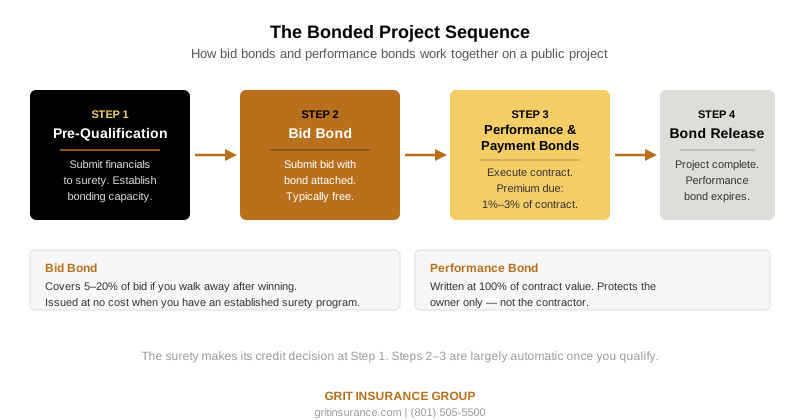
The sequence on a bonded public project typically looks like this:
1. Pre-qualification - You or your bond agent submits your financial information to the surety. The surety reviews and establishes your bonding capacity - the maximum contract value they'll back.
2. Bid bond - You submit your bid with the bid bond attached. If you don't win, the bond is released and nothing happens. If you win, you move to step three.
3. Performance and payment bonds - You execute the contract, your surety issues the P&P bonds, and the project begins. The bond premium - 1% to 3% of the contract value - is due at this stage.
4. Bond release - When you complete the project and the owner accepts the work, the performance bond expires. The payment bond typically stays active through the lien period.
We help contractors qualify for bonds other agents turn down. Take our 2-minute scorecard and we will tell you exactly what your bonding program looks like - and what it could look like.
What Each One Costs
Bid bonds: Free in most cases when you have an established bond program. Some sureties charge a nominal fee - $100 to $200 - on one-off requests without a prior relationship. If you're paying significant money for bid bonds, something is off with your bonding setup.
Performance and payment bonds: 1% to 3% of the contract value for contractors with solid financials and good credit. On a $1 million project, that's $10,000 to $30,000. On a $5 million project, $50,000 to $150,000. Rates go down as project size goes up - most sureties use a sliding scale.
Your specific rate depends on your credit score, the strength of your financial statements, your track record on bonded projects, and the surety relationship you've built over time. Contractors with clean financials, CPA-prepared statements, and an established surety history consistently get closer to 1%. Contractors without that foundation pay more - or have trouble getting bonded at all.
For a full breakdown of what drives bond pricing, see our Surety Bond Cost guide.
Do You Always Need Both?
On public projects - federal, state, and most municipal work - yes. The Miller Act requires performance and payment bonds on federal contracts over $150,000. Most states have their own versions (Little Miller Acts) with similar requirements. Bid bonds are typically required as part of the bidding process before you even get to that stage.
On private commercial projects, bonding requirements vary. Some private owners require performance bonds on larger projects. Others don't require bonds at all. It depends on the owner's risk tolerance and the terms of the contract.
If the bid documents specify a bonding requirement, you need to meet it - no exceptions. If they don't, it's worth asking your client whether they want the additional protection. Some general contractors require subcontractors to provide performance bonds on large subcontracts even when the prime contract doesn't require it.
FAQ
Can you get a bid bond without being able to get a performance bond?
Technically yes, but a reputable surety won't do it. If a surety issues your bid bond, they've assessed your file and determined they're willing to back you. If you win and then find out the surety won't issue the performance bond, you have a serious problem - and a bid bond claim coming your way. Work with a bond agent who qualifies you properly before the bid goes out.
What happens to the bid bond if you don't win?
Nothing. The bond is released, no premium is charged (bid bonds are typically free), and you move on to the next project. There's no downside to submitting a bid bond on a project you don't win.
How far in advance do you need to get a bid bond?
If you have an established surety relationship and your underwriting file is current, bid bonds can usually be issued within 24 to 48 hours. If you're new to bonding or haven't worked with a surety before, the underwriting process takes longer - plan for one to two weeks minimum to get your file in order before you need to start submitting bonds.
Ready to Get Bonded?
If you're bidding on public work and need a bid bond - or you want to build a bond program that makes the whole process faster and cheaper - we can help. Grit works with contractors across the country, and we go to market on your behalf to find the surety that fits your profile best.
Call us at (801) 505-5500 or get a bid bond through Grit.