
You quoted the job, hired the crew, and booked the install. Then your insurance renewal hits and the number is 40% higher than last year.
Sound familiar?
Most HVAC contractors know they need insurance. What most don't know is why they're paying what they're paying - or that they could be paying less without cutting coverage.
Here's what HVAC contractor insurance actually costs in 2026, what drives those numbers, and how to keep them under control.
What HVAC Contractors Actually Pay
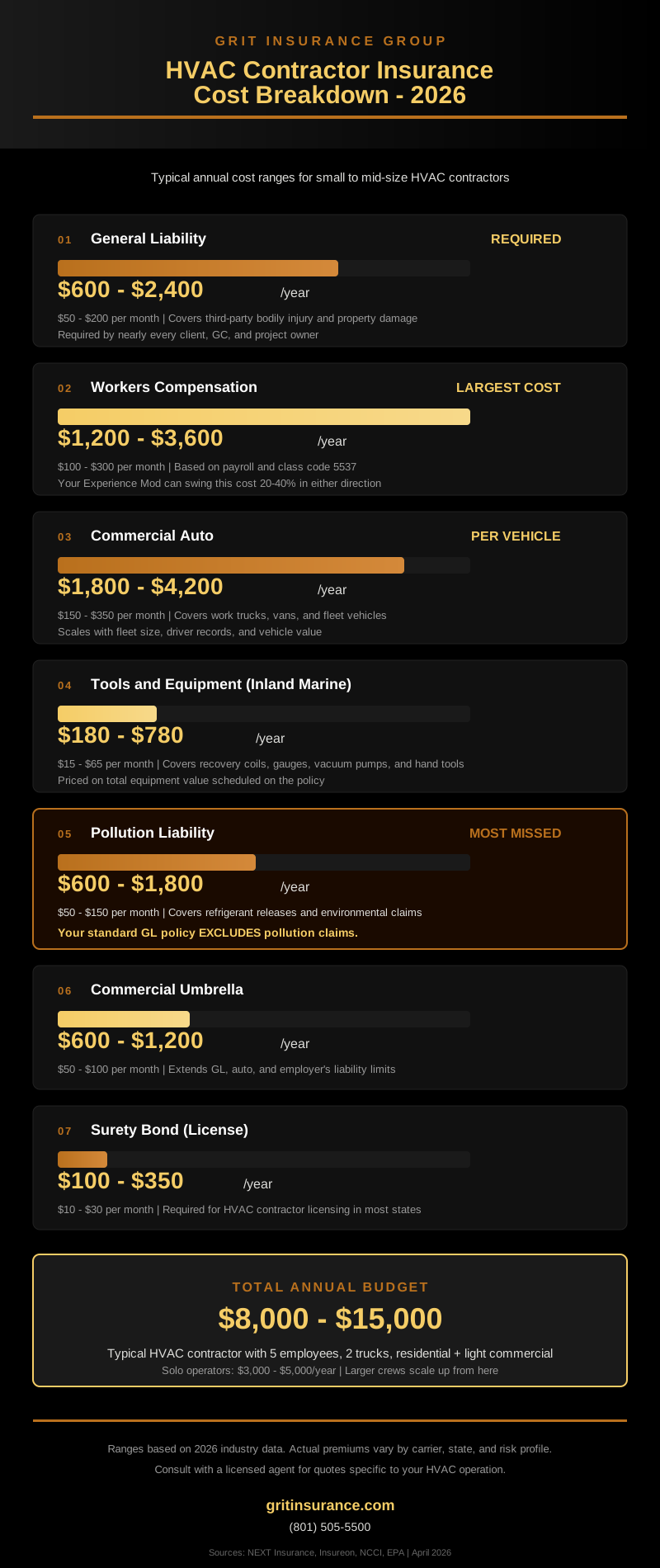
Your total insurance program cost depends on your crew size, the type of work you do, and how your policies are structured. Here are typical annual ranges based on industry data for small to mid-size HVAC contractors.
| Coverage Type | Monthly Range | Annual Range | Who Needs It |
|---|---|---|---|
| General Liability | $50 - $200 | $600 - $2,400 | Every HVAC contractor |
| Workers Compensation | $100 - $300 | $1,200 - $3,600 | Any contractor with employees |
| Commercial Auto | $150 - $350 | $1,800 - $4,200 | Any contractor with work vehicles |
| Inland Marine / Tools | $15 - $65 | $180 - $780 | Contractors with portable equipment |
| Pollution Liability | $50 - $150 | $600 - $1,800 | HVAC contractors handling refrigerants |
| Commercial Umbrella | $50 - $100 | $600 - $1,200 | Contractors wanting higher limits |
| Surety Bond (License) | $10 - $30 | $100 - $350 | Required for licensing in most states |
A typical HVAC contractor with 5 employees, 2 work trucks, and a mix of residential and light commercial work should expect to budget $8,000 to $15,000 per year for a full insurance program.
Solo operators with no employees and one truck can often get started for $3,000 to $5,000 per year. Larger crews with 10 or more employees and a bigger fleet will scale up from there.
These are ranges, not quotes. Your actual cost depends on the six factors below.
Six Factors That Drive Your HVAC Insurance Premium
Most cost guides list three or four factors. Here are six - including two that make a bigger difference than most HVAC contractors realize.
1. Residential vs. Commercial Work Mix
This is the single biggest cost driver most guides skip entirely.
A contractor doing residential HVAC replacements and service calls carries different risk than one installing rooftop units on a commercial building or running ductwork through a hospital.
Commercial HVAC work typically costs more to insure because the projects are larger, the liability exposure is higher, and you're more likely to be required to carry higher coverage limits. General contractors and project owners on commercial jobs will require you as an additional insured with $2M/$4M limits instead of the standard $1M/$2M.
If you do a mix of both, your agent should be structuring your program to reflect the actual split - not just defaulting to the higher-risk classification.
2. Revenue and Payroll
Your general liability premium is rated on revenue. Your workers compensation premium is rated on payroll. The more you gross and the more you pay your crew, the more your insurance costs.
This is straightforward, but here's where HVAC contractors get caught: if your revenue grows mid-year and you don't report it, you'll get hit with an audit adjustment at renewal. Budget for growth. Tell your agent when your numbers change so the adjustment doesn't surprise you.
3. Number of Employees and Subcontractor Use
More employees means more workers comp premium. But what many HVAC contractors don't realize is that uninsured subcontractors can also be included in your workers comp audit.
If you use subs, get certificates of insurance from every one of them before they set foot on a job. If a sub doesn't carry their own workers comp, your carrier may charge you for their payroll as if they were your employee.
4. Claims History
Your claims history follows you. A clean loss run - three to five years with few or no claims - earns you better rates. A history of GL claims, vehicle accidents, or workers comp injuries pushes your premium up.
In workers comp, this shows up as your Experience Modification Rate (EMR or mod). A mod below 1.0 means you're better than average and pay less. Above 1.0 means you're worse than average and pay more. Your mod can swing your workers comp cost by 20% to 40% in either direction.
5. Location
Insurance is regulated state by state. Workers comp rates, auto liability minimums, and even GL pricing vary depending on where you operate. States with higher litigation costs - like New York, California, and Florida - tend to have higher premiums across the board.
If you work across state lines, your insurance program needs to reflect every state where you have payroll or operations.
6. Coverage Limits and Deductibles
Higher limits cost more. Lower deductibles cost more. This is straightforward, but the trade-off is worth understanding.
Many HVAC contractors carry $1M per occurrence / $2M aggregate GL because that's the default. But if you're bidding commercial work or public projects, the GC or project owner will often require $2M/$4M or even $5M. You can get there with either a higher base policy or a commercial umbrella - and an umbrella is usually cheaper than increasing base limits.
The Coverage Most HVAC Contractors Miss: Pollution Liability
Here's something the big online insurance marketplaces don't mention in their HVAC cost guides: pollution liability.
If you handle refrigerants, you have a pollution exposure. Period.
Under EPA Section 608, HVAC technicians must be certified to handle refrigerants. But certification doesn't protect you from liability if a refrigerant release damages a building, contaminates a space, or sends someone to the hospital.
Your standard general liability policy excludes pollution claims. That means a refrigerant leak on a job site - accidental or not - is not covered under your GL.
Here's what that looks like in practice. Your technician is recovering refrigerant from a commercial rooftop unit. A hose fitting fails and R-410A vents into the building's air intake. The building evacuates. Three employees go to the ER. The building owner sends you a bill for remediation and lost business income.
Without pollution liability, you're paying that out of pocket.
Pollution liability coverage for HVAC contractors typically runs $50 to $150 per month. That's a small line item compared to the cost of an uncovered claim.
If your current agent hasn't talked to you about pollution liability, ask them why.
General liability, workers comp, commercial auto, equipment - we package the whole program for contractors. Apply in about 10 minutes and we will get to work.
Workers Comp for HVAC Contractors: Class Codes Matter
Workers compensation is usually the largest single line item in an HVAC contractor's insurance budget. And the cost is driven by your class code.
HVAC contractors are typically classified under NCCI class code 5537 - Heating, Ventilation, Air Conditioning and Refrigeration Systems, Installation, Service and Repair. Some states use variations or state-specific codes, but 5537 is the standard.
Here's why this matters: if you're misclassified - say, lumped in with general plumbing (5183) or electrical work (5190) - you could be paying the wrong rate. Depending on the state, that difference can be significant.
Your workers comp rate is expressed as a cost per $100 of payroll. For HVAC contractors, this typically ranges from $3 to $12 per $100 depending on your state, mod, and carrier. On a $500,000 annual payroll, that's the difference between $15,000 and $60,000 per year in workers comp premium alone.
How to keep your workers comp costs down:
- Make sure your class code is correct for the work you actually do
- Implement a documented safety program (some carriers offer credits for this)
- Return injured workers to light duty as quickly as possible to reduce claim costs
- Review your Experience Mod annually and challenge errors on your loss runs
- Report payroll accurately throughout the year to avoid audit surprises
How Bonding Costs Fit Into Your HVAC Insurance Budget
Most HVAC cost guides don't mention bonding at all. But if you're licensed as an HVAC contractor, there's a good chance your state requires a surety bond.
License bonds are required in most states as part of your contractor license. These typically cost $100 to $350 per year for a $10,000 to $25,000 bond, depending on your credit and the bond amount required by your state.
Performance and payment bonds are a different conversation entirely. If you're bidding on commercial HVAC projects - especially public works - you may need bid bonds, performance bonds, and payment bonds. These are priced based on the contract amount and your financial qualifications, typically running 1% to 3% of the contract value.
Bonding is not insurance. It's a separate financial product with its own underwriting. But it belongs in your budget conversation because it's a real cost of doing business as an HVAC contractor.
Not sure where your bonding program stands? Take the Bond Scorecard - it takes five minutes and gives you a clear picture of your bonding readiness.
How to Lower Your HVAC Insurance Costs Without Cutting Coverage
Paying less doesn't mean carrying less. Here are five ways to bring your HVAC insurance costs down the right way.
1. Bundle Your Policies
A Business Owners Policy (BOP) combines your general liability and commercial property into one policy at a discount. Most small HVAC contractors qualify, and the savings over buying GL and property separately can be 10% to 15%.
2. Invest in Safety
A written safety program, regular toolbox talks, and proper equipment maintenance do more than prevent injuries. They reduce your claims, lower your experience mod, and earn discounts from carriers who track these things.
OSHA's construction standards for fall protection (29 CFR 1926 Subpart M) and lockout/tagout (29 CFR 1910.147) apply directly to HVAC work. Documenting compliance with these standards shows carriers you take risk management seriously.
3. Use Higher Deductibles Where It Makes Sense
Raising your deductible from $500 to $2,500 on your GL or property policy can meaningfully reduce your premium. Just make sure you can cover the deductible out of pocket if a claim hits.
4. Review Your Program Annually
Your insurance program should change as your business changes. If your revenue grew, if you added trucks, if you dropped a service line - your agent should be adjusting the program to match. An annual review catches misclassifications, coverage gaps, and opportunities to save.
5. Work With an Independent Agent
Captive agents represent one carrier. Independent agents shop the market. For HVAC contractors, the difference matters because contractor insurance pricing varies significantly from carrier to carrier.
An independent agent who specializes in contractor insurance can often find better coverage at a lower cost simply by having more options.
Frequently Asked Questions
How much does general liability cost for HVAC contractors?
General liability for HVAC contractors typically ranges from $50 to $200 per month, or $600 to $2,400 per year. The cost depends on your revenue, location, work type (residential vs. commercial), and claims history. Commercial HVAC contractors generally pay more than those doing residential service and replacement work.
Do I need workers comp if I'm a sole proprietor HVAC contractor?
It depends on your state. Some states exempt sole proprietors with no employees from workers comp requirements. But even if you're exempt, many general contractors and commercial clients will require you to carry it before they'll let you on a job site. Check your state's workers compensation board for specific exemption rules.
What insurance do I need to get an HVAC contractor license?
Most states require at least general liability insurance and a surety bond to obtain or renew an HVAC contractor license. Many states also require workers compensation if you have employees. The specific requirements and bond amounts vary by state - verify with your state licensing board before applying.
Does HVAC insurance cost more for commercial work?
Yes. Commercial HVAC work generally costs more to insure than residential work. The projects are larger, the liability exposure is higher, and clients typically require higher coverage limits. If you do a mix of both, make sure your agent is structuring your program to reflect the actual split rather than classifying everything at the higher commercial rate.
How much does a surety bond cost for an HVAC contractor?
License bonds for HVAC contractors typically cost $100 to $350 per year, depending on the bond amount required by your state and your personal credit. Performance bonds for commercial projects cost 1% to 3% of the contract value, depending on your financial qualifications and bonding history. Take the Bond Scorecard to see where you stand.
Is pollution liability really necessary for HVAC contractors?
If you handle refrigerants - and most HVAC contractors do - yes. Your standard GL policy excludes pollution claims. A refrigerant release that causes property damage or bodily injury would not be covered without a separate pollution liability policy. At $50 to $150 per month, it's one of the cheapest policies in your program relative to the exposure it covers.
Get Your HVAC Insurance Program Reviewed
If you're an HVAC contractor paying more than you think you should - or if you're not sure whether your coverage actually matches your risk - talk to the Grit team.
We build HVAC contractor insurance and bonding programs nationwide. We shop the market, find the right carriers for your specific operation, and make sure you're not overpaying or underprotected.
Call us directly: (801) 505-5500
Or start with a quote request and we'll call you.
If bonding is part of the conversation, take the Bond Scorecard first - it gives us a head start on your file.