
Here's the test. Open your Business Auto Coverage declarations page and look at the row that says "Liability." There's a number next to it. Maybe a 1. Maybe a 7. Maybe a 2 with an 8 and a 9 stacked under it.
That number is not decoration. It is the entire definition of which vehicles your auto policy actually covers. Pick the wrong one and you have a six-figure gap in your program that nobody mentioned when you bought the policy.
This article is for contractors. Not CSRs, not risk managers, not the lawyer your GC's risk department sent the certificate to. You. The owner who signs the checks and rides shotgun in the truck when the new guy is still learning the route. By the end of this you will know what every symbol means in plain English, why Symbol 1 is the standard we hold every bonded contractor's auto policy to, and the trap that pulls a front loader or a cherry picker out of your General Liability and into a coverage hole nobody is paying for.
If you'd rather just have us look at it, call (801) 505-5500. Otherwise, keep reading.
What Commercial Auto Symbols Actually Are
Commercial auto policies use a numbered shorthand to describe which vehicles are covered for each kind of coverage. The Insurance Services Office (ISO) Business Auto Coverage Form (CA 00 01) lists symbols 1 through 9 plus 19. Truckers, motor carriers, and garage operations have their own symbol sets. We are talking about the standard business auto form, which is what almost every contractor in America carries.
Symbols sit on your declarations page next to each coverage line. The most important one is the Liability symbol because liability is the coverage that pays the third party when your driver causes an accident. The number next to "Liability" controls who gets defended and indemnified, and who does not.
Different symbols can apply to different coverages on the same policy. Liability might be Symbol 1. Physical damage might be Symbol 7. Uninsured motorist might be Symbol 6. Each line stands alone. That is by design and it is also where most contractor programs get sloppy.
All 10 Symbols in Plain English
| Symbol | What It Covers | Plain English |
|---|---|---|
| 1 | Any "Auto" | Anything with wheels you drive for work, owned or not. Broadest coverage available. |
| 2 | Owned "Autos" Only | Only vehicles you own. Includes new vehicles you buy during the policy term. |
| 3 | Owned Private Passenger "Autos" Only | Only owned cars and SUVs. Trucks and trailers excluded. |
| 4 | Owned "Autos" Other Than Private Passenger | Only owned trucks, trailers, and commercial vehicles. Cars excluded. |
| 5 | Owned "Autos" Subject to No-Fault | Owned vehicles registered in no-fault states. |
| 6 | Owned "Autos" Subject to Compulsory UM Law | Owned vehicles in states that require uninsured motorist. |
| 7 | Specifically Described "Autos" | Only the vehicles listed by VIN on the schedule. If it is not on the list, it is not covered. |
| 8 | Hired "Autos" Only | Vehicles you rent, lease, or borrow from a rental company. Does not cover renting from your own employee. |
| 9 | Non-Owned "Autos" Only | Employee personal vehicles used for company business. Covers the company, not the employee. |
| 19 | Mobile Equipment Subject to Compulsory or Financial Responsibility Law | Land vehicles classified as mobile equipment that the state requires to carry auto insurance. |
The first thing to notice is that no two symbols cover the same thing. Stacking 2, 8, and 9 gets you most of the way to Symbol 1 but not all the way. We will get to why in a minute.
The second thing to notice is Symbol 19. Most contractors have never heard of Symbol 19. By the end of this article, anyone with a backhoe, a cherry picker, or a road maintenance rig is going to want to know whether it is on their policy.
Why Symbol 1 Is the Grit Standard
Our standard for any contractor's commercial auto liability is Symbol 1. Always go for the best. There is no combination of other symbols that covers as much ground.
Symbol 1 covers any auto. Owned, leased, rented, hired, borrowed, employee-owned, just-bought-this-morning. If it has wheels and someone drove it for the business, the coverage responds. There is no "is it on the schedule" question. There is no "did we report the new truck within 30 days" question. The contract simply says any auto and means it.
The IRMI definition uses the phrase "no limitations" intentionally. Auto status as owned, non-owned, hired, borrowed, or whatever it is, it is covered. That is the point.
For a contractor, this matters in three real-world situations:
The truck you bought yesterday. Symbol 7 only covers vehicles on the schedule. If you closed on a new F-450 Friday afternoon and your driver T-bones a sedan Saturday morning, the Symbol 7 policy is going to ask why the new truck was not reported. Symbol 1 already covered it the moment you took possession.
The rental. Your truck is in the shop. The crew rents a one-ton from U-Haul to finish the week. Symbol 8 covers it. Symbol 7 does not. Symbol 1 does.
The employee in their own pickup. Foreman drives his personal truck to pick up materials. Hits a pedestrian. Symbol 9 covers the company's exposure (vicarious liability). Symbol 7 does not. Symbol 1 does.
Stacking Symbols 2, 8, and 9 covers most of these scenarios but leaves real gaps. Symbol 8 specifically excludes vehicles rented from an employee. Symbol 9 only covers the business, not the employee personally. Symbol 1 closes both gaps without you having to remember the exclusions.
We have seen contractor policies written on Symbol 7 because the agent thought it would save premium. The savings are real. So is the exposure. A single excluded vehicle in a serious crash and the savings disappear in the first phone call from the claims attorney. Symbol 1 costs more for a reason.
The Symbol 7 Trap
If your declarations page says Symbol 7 next to Liability, you have a job to do every time you add a vehicle. You have to report it to your agent, get the schedule updated, and confirm the new VIN is on the policy.
Most contractors do not. Trucks come and go. Trailers get added. The fleet manager swaps a unit out and forgets to call. By the end of a busy season, the schedule on file with the carrier and the actual fleet sitting in the yard do not match.
Some carriers grant a 30-day or 60-day grace period for newly acquired vehicles, but only if you eventually report them. If you do not report at all, even the grace period evaporates. And the grace period only applies to acquisition. It does not cover the rental you forgot to call in, the trailer you bought at auction, or the truck your son-in-law drove home from a job site one Friday.
Symbol 1 does not have this problem. Symbol 7 does. That is the trap.
If your dec page says Symbol 7 and you do not have a tight, written process for reporting every vehicle change to your agent within 24 hours, you are running a coverage gamble. Most contractors do not realize they are gambling until a claim hits.
When Mobile Equipment Stops Being Mobile Equipment
Now the part nobody talks about.
Your General Liability policy (the CGL) covers your work, your premises, and your products. It also covers the operation of mobile equipment. Forklifts, backhoes, bulldozers, cherry pickers, road maintenance rigs, concrete pumps, and a long list of other contractor gear are defined as mobile equipment under the standard ISO CGL.
Mobile equipment is supposed to be covered under your CGL. Auto exposures are supposed to be covered under your Business Auto Policy. The two coverages are split on purpose. The problem is the line moves.
In December 2004, ISO revised the CGL definition of mobile equipment. Under the current form, any land vehicle that is "subject to a compulsory or financial responsibility law or other motor vehicle insurance law in the state in which the vehicle is licensed or principally garaged" is no longer mobile equipment. It is now an "auto" under the policy. And the CGL excludes autos.
Read that again. The state can pull a piece of equipment out of your CGL by passing a law that requires that equipment to carry auto insurance. The decision is not yours. The decision is not your agent's. It is your state's.
Different states treat this differently. Some require highway-class vehicles built on truck chassis to carry auto registration and insurance even when the equipment they carry (cherry picker, sign-mounted truck, road maintenance rig) is the actual revenue-generating part. Other states have specific carve-outs for off-road equipment that occasionally drives on public roads to get from job site to job site. The patchwork is real and it is your exposure to manage.
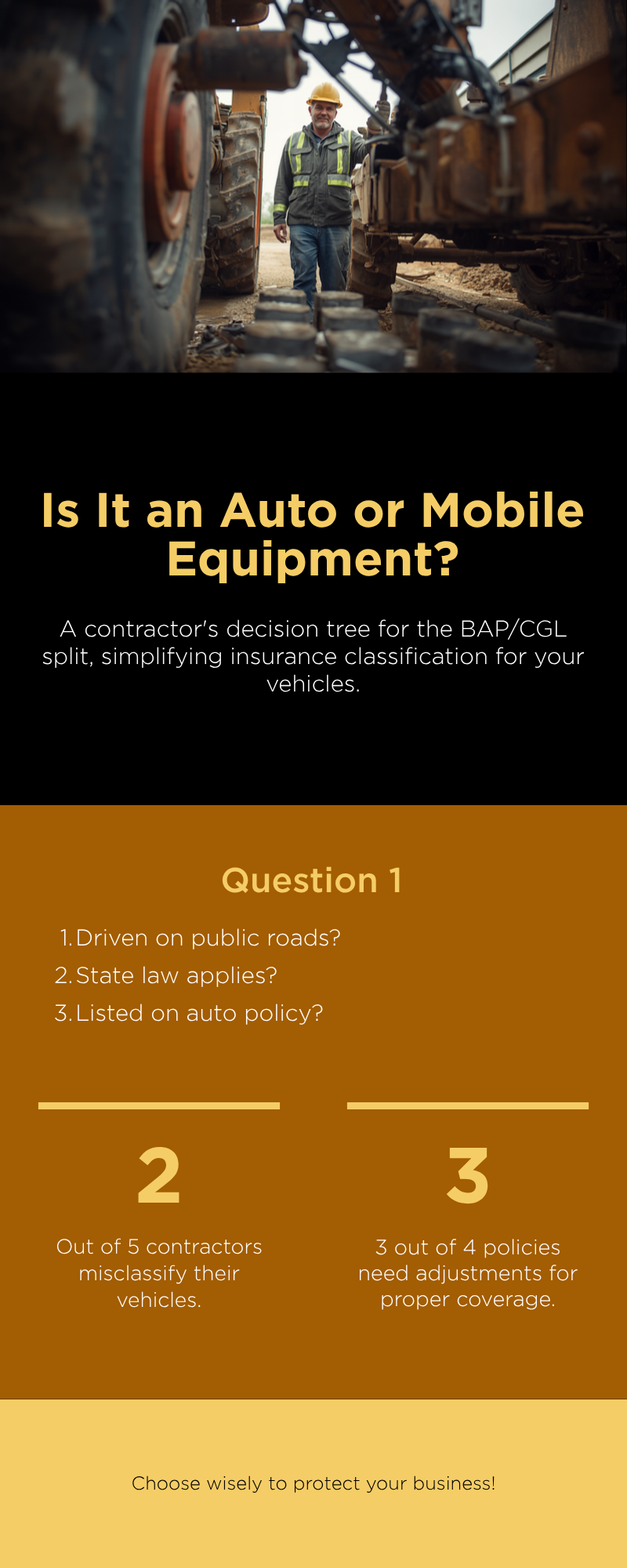
Here is the practical version. The vehicle is "auto" when it is being driven on public roads. It is "mobile equipment" when it is being operated. The CGL still covers operation of attached equipment. The CGL does not cover the road exposure when the state has compelled auto insurance on that vehicle.
The Symbol 19 / mobile equipment endorsement under the BAP is the bridge that closes the gap. If you have road-driven equipment and you do not have Symbol 19 or a written mobile equipment endorsement on your auto policy, you have a hole in your program that nobody is filling.
State-specific compulsory insurance and financial responsibility laws determine which equipment is treated as auto in your operating territory. Verify with a licensed advisor before relying on this article for any specific compliance decision. We can run that check for any state Grit operates in.
General liability, workers comp, commercial auto, equipment - we package the whole program for contractors. Apply in about 10 minutes and we will get to work.
Who's Most Exposed
Some trades have more of this exposure than others. If your business runs any of the following equipment on public roads, the BAP/CGL split is your problem to solve before the claim, not after.
Excavation and Civil. Backhoes, skid steers, and front loaders that drive between job sites on public streets. The compulsory insurance trigger varies by jurisdiction.
Highway and Road Maintenance. Anything DOT-spec, anything with rotating beacon lights, anything that pulls into traffic to perform work. Almost always pulled out of CGL by state law.
Concrete Pumping. Truck-mounted booms drive on highways. State law in most jurisdictions treats them as autos. CGL is gone the moment the wheels turn.
Demolition and Hazmat. Specialty trucks with attached equipment. State treatment varies, exposure is high.
Pipeline, Utility, and Telecom. Cherry pickers, line trucks, augers. These almost always trigger compulsory auto insurance because they share roadways with the public.
Landscaping with Truck-Mounted Equipment. Tree care rigs with bucket booms. Spray rigs on truck chassis. The truck side is auto. The boom side is the question.
Crane and Lift Services. Truck-mounted cranes are autos when driven and equipment when set up. Almost every state pulls them into auto when on public roads.
Anyone with a Cherry Picker on a Truck Chassis. Sign companies, painting contractors with high-reach equipment, electrical line crews. If it drives, the state probably classifies it as auto.
If your trade is on this list and you cannot tell us whether your auto policy carries Symbol 1 or has a mobile equipment endorsement, you have a problem worth a 30-minute phone call to find.
How to Read Your Dec Page in 60 Seconds
Pull up your Business Auto Declarations page (your agent has it, your insurance binder has it, the carrier portal has it). You are looking for three things.
One: the Liability line. What number is next to it? If it says 1, you are running on broadest coverage and you are good to go. If it says 7, you have the schedule problem. If it says a stack like 2, 8, 9, you have most of the coverage but with the gaps we covered above. If you cannot find a number at all, something is wrong with the dec page and you need a new one.
Two: the Physical Damage lines (Comprehensive, Collision). These are usually Symbol 7 on most contractor programs because physical damage is rated per vehicle. That is normal. The exception is if you want broader physical damage on hired or non-owned autos, which requires specific symbols.
Three: any reference to mobile equipment, Symbol 19, or a mobile equipment endorsement. If you have road-driven equipment and you do not see any of these on your dec page, that is the gap.
If any of those three checks fail, write down what you found. Take it to your agent. Ask them to write you the difference between Symbol 1 and what you have, and to walk you through how mobile equipment is treated in your operating states.
What to Ask Your Agent This Week
Three questions. Plain English. No hedging.
- Is my Business Auto Policy written on Symbol 1 for liability? If not, why not, and what does it cost to upgrade?
- Do I have Symbol 19 or a mobile equipment endorsement on my auto policy for the equipment I drive on public roads? Can you list each piece of equipment and tell me whether it is auto or mobile equipment in each state I work in?
- If I had a major auto liability claim involving a piece of mobile equipment driving between job sites tomorrow, which policy would respond, and is there a coverage gap between the BAP and CGL that I am self-insuring without knowing it?
If your agent cannot answer those three questions in writing within 48 hours, that tells you something. If the answer to question one is "Symbol 7 because it is cheaper," that tells you something. If the answer to question three is a vague reassurance instead of a clear answer, that tells you something too.
A Word for Bonded Contractors
If you carry a bonding program for public works or commercial bid work, the surety underwriter assumes your auto coverage actually responds when called. A six-figure auto liability claim that gets denied because the wrong symbol was on your dec page hits your CPA-prepared financials in the very next reporting cycle. That cuts your bonding capacity exactly when you need it.
Symbol 1 plus Symbol 19 / mobile equipment endorsement is what we recommend on every Grit bonded-contractor program. It is the cleanest way to keep the BAP, the CGL, and the bonding program all pulling in the same direction.
If you are not sure where you stand on capacity, take the Contractor Bond Scorecard. It takes about five minutes and shows you exactly what a surety would see when reviewing your file.
FAQ
Is Symbol 1 the same as full coverage?
No. "Full coverage" is a marketing phrase, not a coverage definition. Symbol 1 defines which vehicles are covered. You still need the right limits, deductibles, and additional coverages (uninsured motorist, hired auto physical damage, mobile equipment) on top of the symbol.
What is the difference between Symbol 7 and Symbol 1?
Symbol 7 only covers vehicles specifically listed on the policy schedule. Symbol 1 covers any vehicle, scheduled or not, owned or borrowed. Symbol 1 is broader. Symbol 7 is cheaper but requires perfect fleet reporting discipline.
What is Symbol 19 on a commercial auto policy?
Symbol 19 covers mobile equipment that is subject to a state's compulsory insurance law or financial responsibility law. It is the bridge between mobile equipment (CGL territory) and autos (BAP territory) when state law pulls a piece of equipment into the auto definition.
Does my CGL cover my front loader on the road?
Probably not, if your state has a compulsory auto insurance law that applies to that piece of equipment. The 2004 ISO CGL revision pulled state-compelled equipment out of the mobile equipment definition. Your CGL still covers operation of the equipment. The road exposure is auto, not CGL.
Should every contractor be on Symbol 1?
We recommend Symbol 1 for any contractor with a fleet of more than two vehicles, any contractor who rents trucks, any contractor with employees who drive personal vehicles for work, and any bonded contractor of any size. Single-truck owner-operators with no rentals and no employees can sometimes operate on Symbol 7 if the schedule discipline is real, but the savings are usually too small to justify the trap.
What is the Mobile Equipment Endorsement?
A separate endorsement that adds coverage for non-auto mobile equipment to your commercial auto policy. It is one of the two ways to handle the BAP/CGL split (Symbol 19 is the other). Some carriers prefer one over the other. Either works if it is in writing.
What do symbols 8 and 9 mean on commercial auto insurance?
Symbol 8 is Hired "Autos" Only - vehicles you rent, lease, or borrow from a rental company. Symbol 9 is Non-Owned "Autos" Only - employee personal vehicles driven for company business. Agents usually add both on top of Symbol 2 (owned autos) to get close to Symbol 1. Close is not the same as equal. Symbol 8 does not cover a vehicle you rent from your own employee, and Symbol 9 covers the company's liability, not the employee personally. Stacking 2, 8, and 9 leaves both of those gaps open. Symbol 1 closes them without you having to remember the exclusions.
What is symbol 6 on a commercial auto policy?
Symbol 6 is Owned "Autos" Subject to a Compulsory Uninsured Motorists Law - the owned vehicles registered or garaged in states that require uninsured motorist coverage. It shows up on the Uninsured Motorist line of your declarations page, not the Liability line. Because it is driven by state law, which of your vehicles it picks up depends on where each one is registered, so it can change when you move a truck across state lines.
What to Do Next
If you have read this far, you already know whether your policy is sloppy or tight. Symbol 1 plus the right mobile equipment treatment is the standard we hold every bonded-contractor program to. If your current policy is anything else, there is a conversation worth having.
Call us at (801) 505-5500 and one of the team will pull your dec page apart with you. We will tell you exactly what is covered, what is not, and what it costs to close the gap. No hard pitch. Just a clean read.
If you would rather start with bonding, the Contractor Bond Scorecard shows you where you stand on bonding capacity in five minutes. It pairs naturally with the auto coverage review because the surety is going to look at both before assigning capacity.
Either way, the goal is the same. Get your program tight before the claim, not after.